When a civilization preserves the most sacred remains of a spiritual teacher, we must ask a simple question: why there?
Would the deepest relic tradition of a great spiritual figure normally grow far away from the true homeland of that figure? Or would it remain rooted in the land where that person lived, taught, and transformed the lives of the people around him?
This question matters deeply when we examine the origins of Lord Buddha.
For generations, the mainstream historical narrative has placed the life of Prince Siddhartha Gautama in the geography of present-day India and Nepal. That view has been repeated so often that many people accept it without asking whether the full body of evidence has really been tested. But when we look closely at Sri Lanka’s relic tradition, sacred geography, royal custodianship, and continuous devotional memory, the island emerges as a place that deserves far more serious attention.
Sri Lanka is not just another Buddhist land with a few borrowed relics and later devotional structures. It preserves one of the most complete and integrated relic traditions in the Buddhist world. Hair relics, bodily relics, the Sacred Tooth Relic, the Bodhi lineage, and a network of major pilgrimage sites are not small side elements of Lankan Buddhism. They are woven into the very spiritual and political identity of the island.
This article does not argue that relic tradition alone settles the matter completely. But it does argue something important: Sri Lanka’s extraordinary relic system is not easy to explain if the island was only a distant secondary recipient. On the contrary, that relic system strengthens the case that ancient Hela Diva may have held a far more original and primary connection to Lord Buddha than mainstream history has allowed.
Why Relic Custodianship Matters
Across human history, the most sacred relics of a civilization’s most revered figures tend to remain close to the places most deeply associated with them. Relics are not just religious objects. They are symbols of identity, legitimacy, continuity, and sacred memory.
The stronger the relic tradition, the stronger the civilizational claim behind it.
This does not mean relics never moved. History includes transfers, gifts, war seizures, protective relocations, and changing custodianship. But those cases do not erase the wider pattern: major relic cultures usually grow where devotion, memory, and identity are most deeply rooted.
That is why Sri Lanka’s case is so striking.
Sri Lanka does not preserve just one isolated relic story. It preserves a broad and organized sacred landscape. The island’s relics are tied to stupas, kingship, pilgrimage, ritual continuity, and national memory. They are not treated like foreign trophies. They are treated like inherited sacred trust.
That difference should not be ignored.
Sri Lanka’s Relic Tradition Is Not Marginal
In many Buddhist countries, relics are treasured as precious inheritances. In Sri Lanka, however, relics stand near the center of the religious civilization itself.
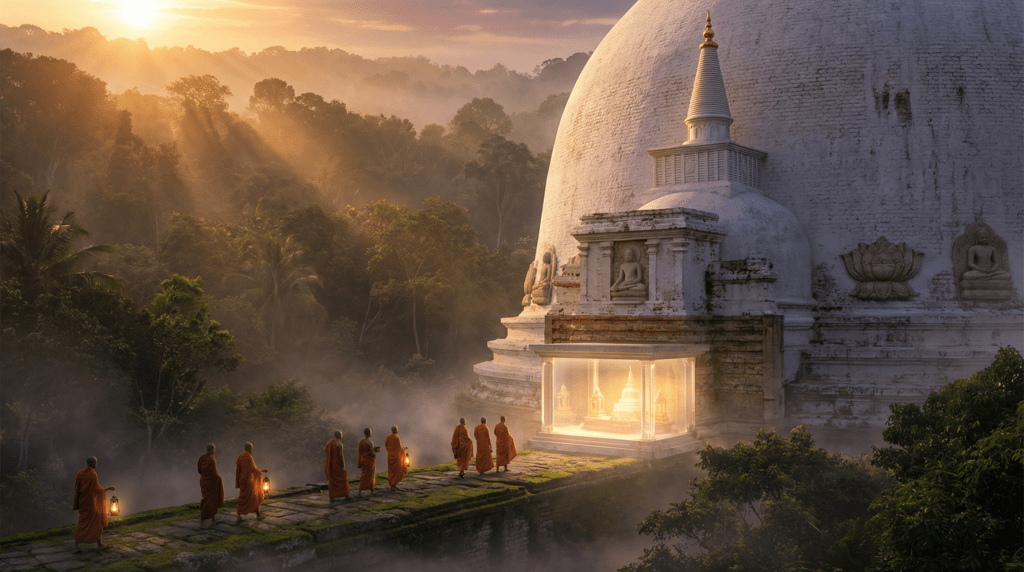
The island’s great stupas were not casual monuments. They were built as sacred enshrinement centers. Major relic traditions are associated with places such as Mahiyangana, Ruwanwelisaya, Kiri Vehera, Kelaniya, and the Temple of the Tooth in Kandy. Whether one examines chronicles, ritual practice, or royal sponsorship, the same pattern appears again and again: relic preservation in Sri Lanka is ancient, intentional, and civilizational.
This raises a difficult question for the mainstream narrative.
If Sri Lanka was only a distant receiver of fragments from a foreign homeland, why did such a complete and enduring relic culture become so deeply rooted here? Why did kings fight to protect these relics? Why were stupas built on such a scale? Why were relics tied not only to worship, but to sovereignty itself?
These are not small questions. They go to the heart of historical identity.
A Comparison Worth Examining
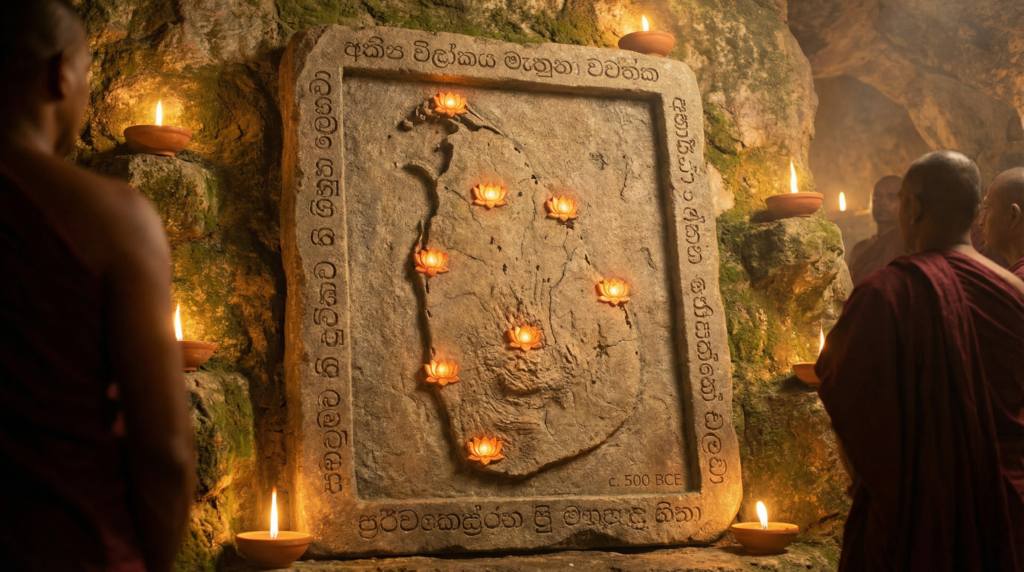
The issue is not whether India and Nepal are important in Buddhist history. Of course they are. The real issue is whether the strength, continuity, and integration of Sri Lanka’s relic tradition may point to something more original than the mainstream model admits.
A careful comparison helps show why this question deserves serious attention.
| Feature | Sri Lanka tradition | Common mainstream view | Historical question raised |
|---|---|---|---|
| Bodily relic tradition | Sri Lanka preserves a strong relic-centered sacred network across major sites associated with bodily relics, including important stupas and long-standing veneration traditions. | Mainstream history places the Buddha’s life mainly in India/Nepal and treats Sri Lanka as a later custodian of important relics. | Why did Sri Lanka develop such a broad and enduring bodily relic culture if it was only secondary? |
| Sacred Tooth Relic | The Tooth Relic became central to kingship, sovereignty, and legitimacy in Sri Lanka for centuries. | The mainstream homeland narrative does not present an equally central, uninterrupted sovereignty tradition built around a tooth relic in India/Nepal. | Does the political centrality of the Tooth Relic in Sri Lanka suggest a deeper and older custodianship? |
| Bodhi lineage | The Jaya Sri Maha Bodhi was preserved with extraordinary ritual and historical continuity. | Bodh Gaya remains central in mainstream tradition, but the Lankan Bodhi lineage became one of the most continuously protected sacred living traditions in the Buddhist world. | Why did Sri Lanka become such a powerful center of living Bodhi continuity? |
| Relics and national identity | In Sri Lanka, relics became tied to kingship, pilgrimage, state memory, and the sacred identity of the land. | India and Nepal hold major Buddhist sacred sites, but the relic-state relationship developed differently there. | Why did Sri Lanka integrate relics so deeply into national and royal legitimacy? |
| Archaeology and relic culture | Sri Lanka contains major stupas, relic shrines, and long-standing devotional continuity linked to relic worship. | Archaeological sites in India/Nepal are significant, but are often discussed more through excavation and textual reconstruction than continuous island-wide relic-state culture. | What does the difference in continuity and integration suggest? |
| Pali Canon geography | Some alternative researchers argue that many Pali descriptions fit Sri Lankan geography more closely than is usually admitted. | Mainstream scholarship maps the Pali Canon largely onto North India and Nepal. | Which geography fits better when the texts are re-examined without inherited assumptions? |
This table does not claim to prove everything by itself. But it highlights something that should not be dismissed: Sri Lanka’s relic system is unusually complete, unusually integrated, and unusually alive.
The Sacred Tooth Relic and Sovereignty
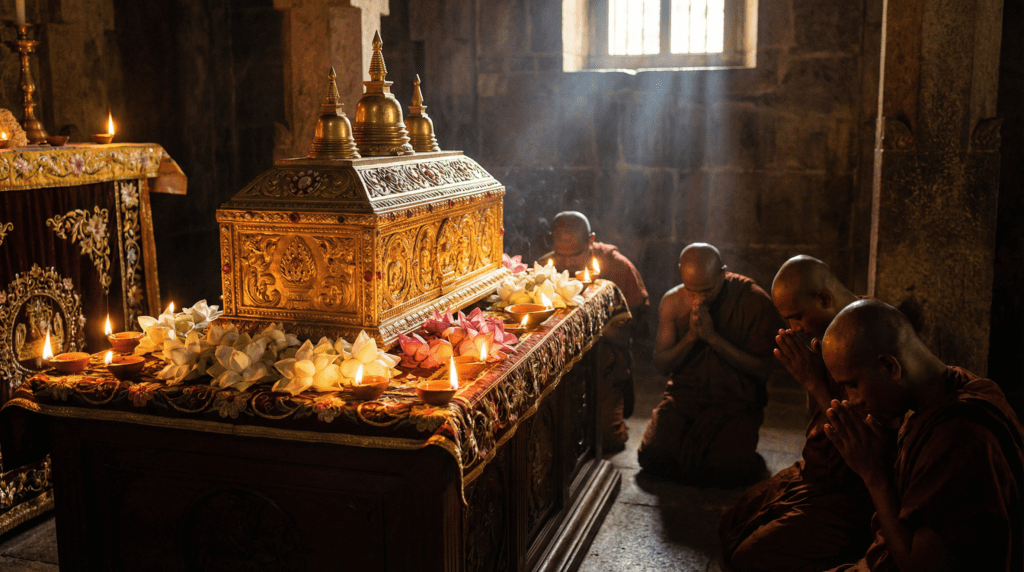
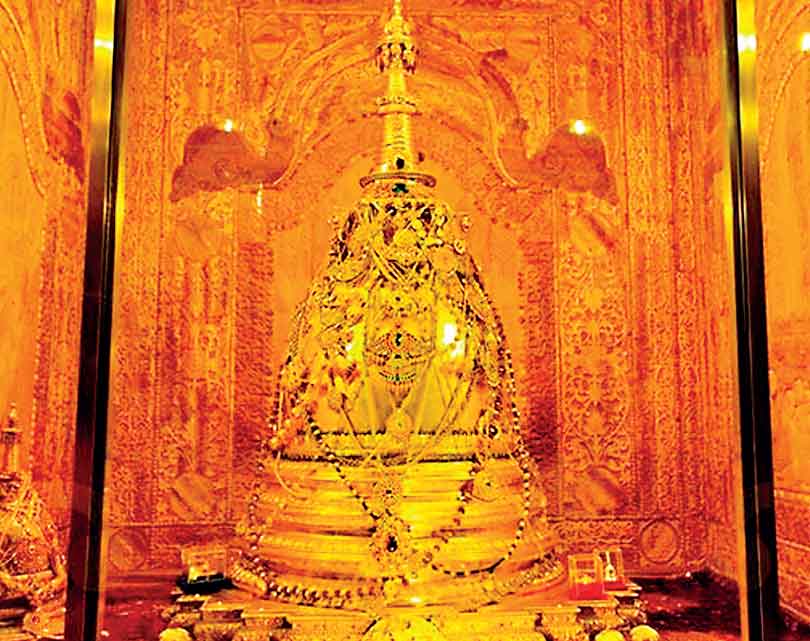
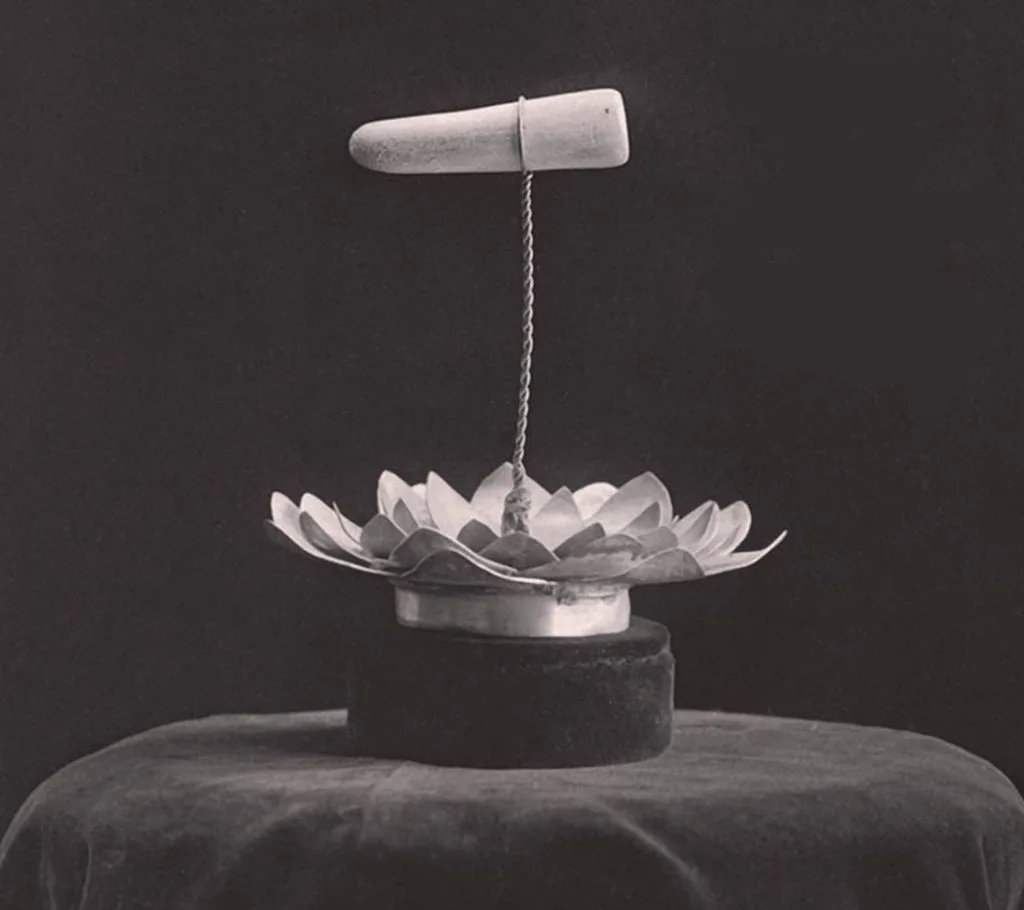
Among all Sri Lanka’s relic traditions, the Sacred Tooth Relic stands out as the most politically powerful.
For centuries, possession of the Tooth Relic was closely tied to the right to rule. The king who held the relic was not merely a political leader. He was understood as the legitimate guardian of the land’s sacred inheritance. This is one of the strongest examples in Buddhist history of a relic becoming central to statecraft itself.
That matters enormously.
A relic does not become the heart of sovereignty in a civilization unless that civilization sees it as central to its own identity. Sri Lanka did not treat the Tooth Relic as a decorative import. It treated it as a pillar of sacred kingship.
Its movement through Anuradhapura, Polonnaruwa, Dambadeniya, Kurunegala, Gampola, Kotte, and Kandy mirrors the political history of the island. Wherever the center of power moved, the relic moved with it. That is not the behavior of a people holding a distant foreign memory at arm’s length. That is the behavior of a civilization guarding its living spiritual core.
This does not by itself prove that Lord Buddha was born in Sri Lanka. But it does strongly support the claim that Sri Lanka understood its relationship to the Buddha as direct, foundational, and ancient.
The Bodhi Tradition as Living Continuity
The Jaya Sri Maha Bodhi in Anuradhapura adds another important layer to the argument.
Unlike a relic enclosed in stone or metal, the Bodhi tradition is living. It must be protected continuously. It must be remembered ritually. It must be cared for across generations. That makes it one of the strongest forms of visible civilizational continuity.
Sri Lanka preserved that continuity with extraordinary seriousness.
If the island were merely peripheral to the Buddha’s story, this level of long-term centrality would already be remarkable. But within the Buddha of Lanka framework, the Bodhi tradition makes even deeper sense. It becomes not only a received sacred symbol, but part of a wider indigenous sacred memory tied to the very land itself.
Whether one accepts that conclusion fully or not, the intensity of Bodhi veneration in Sri Lanka is historically significant. It points to a relationship far deeper than casual transmission.
Sacred Geography and the Island-Wide Pattern
Another major strength of the Lankan case is that its relic tradition is not isolated in one city or temple. It is spread across the island in a way that creates a sacred map.
That is important.
A civilization can inherit a relic. But creating an island-wide sacred geography around multiple relic centers suggests something bigger. It suggests an understanding of the land itself as blessed, marked, and remembered through the physical presence of the Buddha.
This is where the broader Buddha of Lanka theory becomes especially powerful. The relics are not standing alone. They sit alongside claims about place names, ancient chronicles, pilgrimage records, inscriptions, and reinterpretations of sacred geography. Whether every identification is correct or not, the framework is at least coherent: Sri Lanka is being read not as a peripheral receiver, but as the original stage on which the life of Lord Buddha unfolded.
That is a serious historical proposal, and it should be tested seriously.
The Weak Point in the Mainstream Assumption
The mainstream narrative often assumes that Sri Lanka’s relics can be explained simply as gifts, transfers, or secondary developments. But this explanation becomes weaker when we examine the total pattern.
A few relics could be explained that way. A single shrine could be explained that way. Even a strong devotional tradition might be explained that way.
But a dense and continuous network of relic culture, tied to kingship, sacred geography, monumental architecture, ritual continuity, and national memory over centuries, is not so easily dismissed.
At the very least, this pattern demands a better explanation than the usual simplified story.
Why did Sri Lanka become such a powerful center of relic civilization?
Why were the relics not treated as marginal imports, but as the very heart of legitimacy and sacred identity?
Why does the island preserve such a strong fusion of relic, land, and memory?
These questions do not disappear just because the conventional narrative is old.
A Call for Re-examination
The point of this discussion is not blind nationalism and not emotional reaction. It is historical re-examination.
Sri Lanka’s relic tradition should be studied alongside inscriptions, textual geography, royal chronicles, archaeology, and pilgrimage records. It should not be pushed aside as a mere devotional afterthought while all authority is automatically assigned elsewhere.
If the Buddha of Lanka theory is wrong, it should be disproved with serious evidence, not with inherited assumptions.
If the theory has strength, then Sri Lanka’s relic system is one of the places where that strength is most visible.
Because relics are not only objects.
They are memory in material form.
They are continuity made visible.
They are the fingerprints of civilizational truth.
Conclusion
Sri Lanka’s relic tradition is too extensive, too integrated, and too historically central to be treated as a minor side note in Buddhist history.
The Sacred Tooth Relic, the Bodhi lineage, the great relic stupas, and the island-wide sacred geography together form a pattern that deserves much deeper investigation. That pattern does not automatically settle every question. But it does raise a powerful challenge to the conventional view that Sri Lanka was only a secondary recipient of the Buddha’s sacred legacy.
A civilization does not usually build its sovereignty, sacred architecture, pilgrimage memory, and spiritual identity around relics unless those relics are understood as part of its own deepest inheritance.
That is why Sri Lanka’s relic tradition matters.
It may not stand alone as proof. But it stands as one of the strongest signatures in the larger case that ancient Hela Diva was not merely a guardian of the Buddha’s memory.
It may have been the land where that memory began.
Read more on the topic:
 Did India Really Give Away the Buddha’s Most Sacred Relics to Sri Lanka?
 The Lost Rivers of Hela Diva: How Colonial Renaming Hid the Buddha’s Real Homeland
 The Four Hela Clans — Yakka, Nāga, Deva & Raksha: The Real People Behind the “Demons” of Lanka
 Hidden in Plain Sight: Historical Records That Link the Buddha to Sri Lanka